Loading...
Closed-loop profit recovery
Finding the money is the easy part.Proving you got it back is the product.
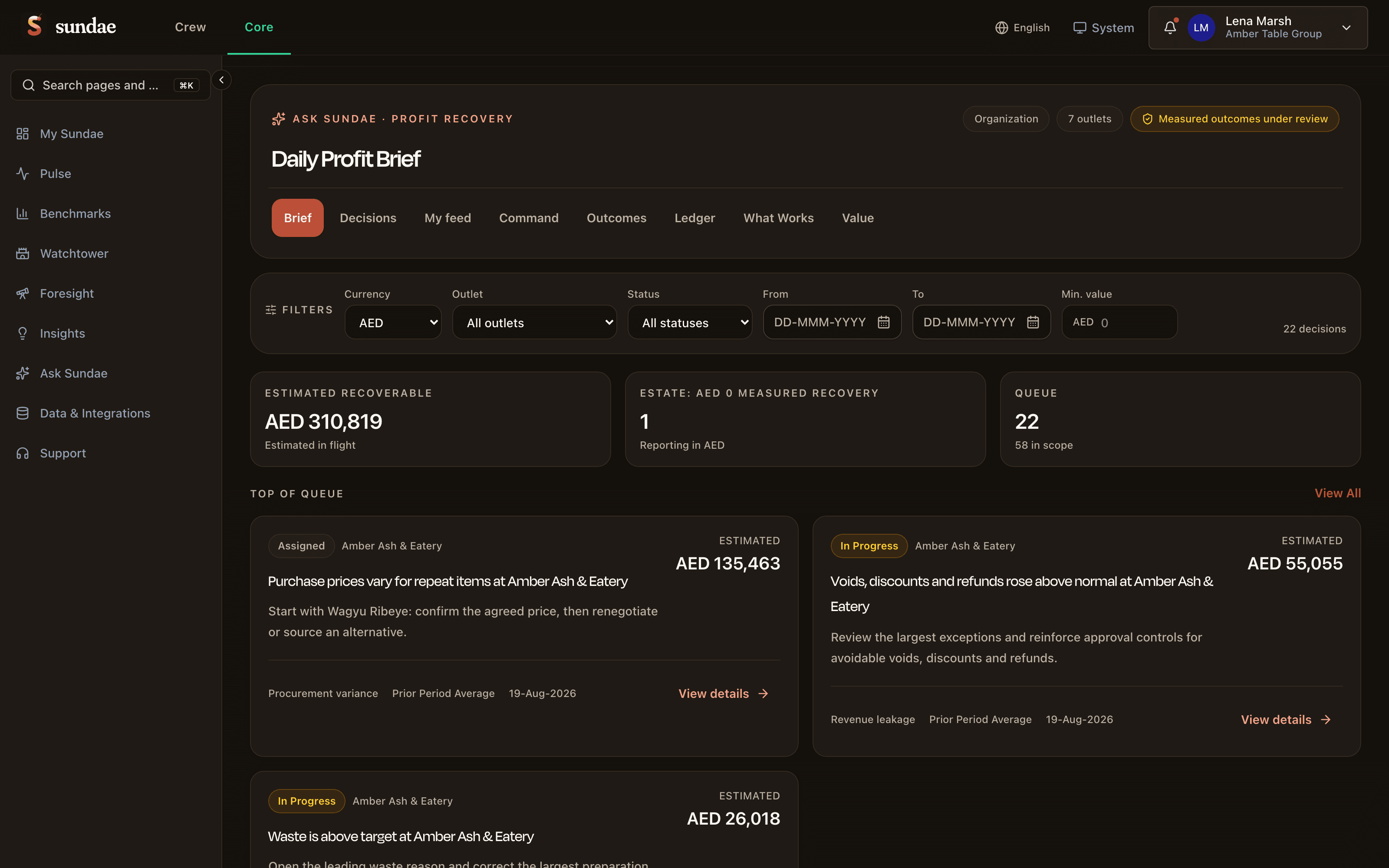
Most tools stop at the flag. Sundae opens the evidence, gives the work to one accountable owner, freezes the baseline and measures what came back.

THE LOOP
Five steps. None of them end at a dashboard.
Detect
Fourteen detectors read real operating data. When the evidence is not there, Sundae abstains instead of inventing an opportunity.
Decide
Every opportunity carries its value, source, scope and evidence so the operator can accept it, decline it or inspect it further.
Execute
One accepted decision becomes exactly one task for one named owner, with no duplicate action chasing the same leak.
Measure
Completion freezes the applicable baseline, starts the measurement window and shows when the result is due.
Learn
Measured outcomes feed What Works, graded by evidence strength, so the next recommendation learns from your operation.

PROOF HEALTH
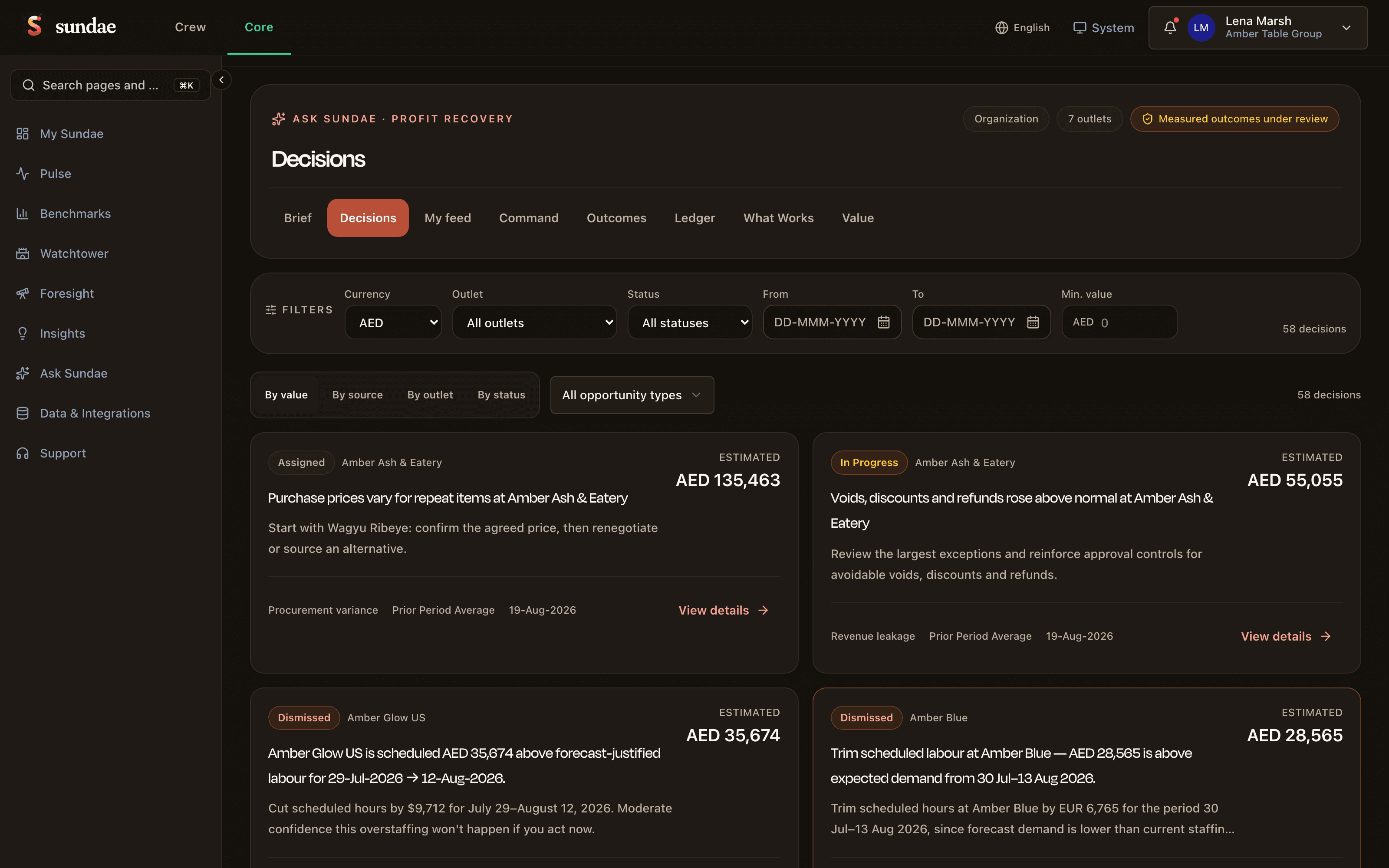
Four questions every recovery claim should survive.
Sundae does not hide the weak parts of the loop. It shows whether work closes, whether the evidence is complete and whether the amount still ties back.
Loop Health
Did the process close?
See detected-to-measured close-rate, source performance, abstain reasons and the weekly trend.
Evidence health
Did the full dataset arrive?
Connector-backed evidence is certified only when the whole evidence window arrives without gaps.
Reconciliation
Does the amount still tie?
Supported sources are rechecked against live records and show reconciled, records changed or unavailable.
Value
Did measured recovery cover the cost?
Measured recovered value is compared with Sundae's list subscription cost without mixing in estimates.

THE LIMITS
What Sundae will not do.
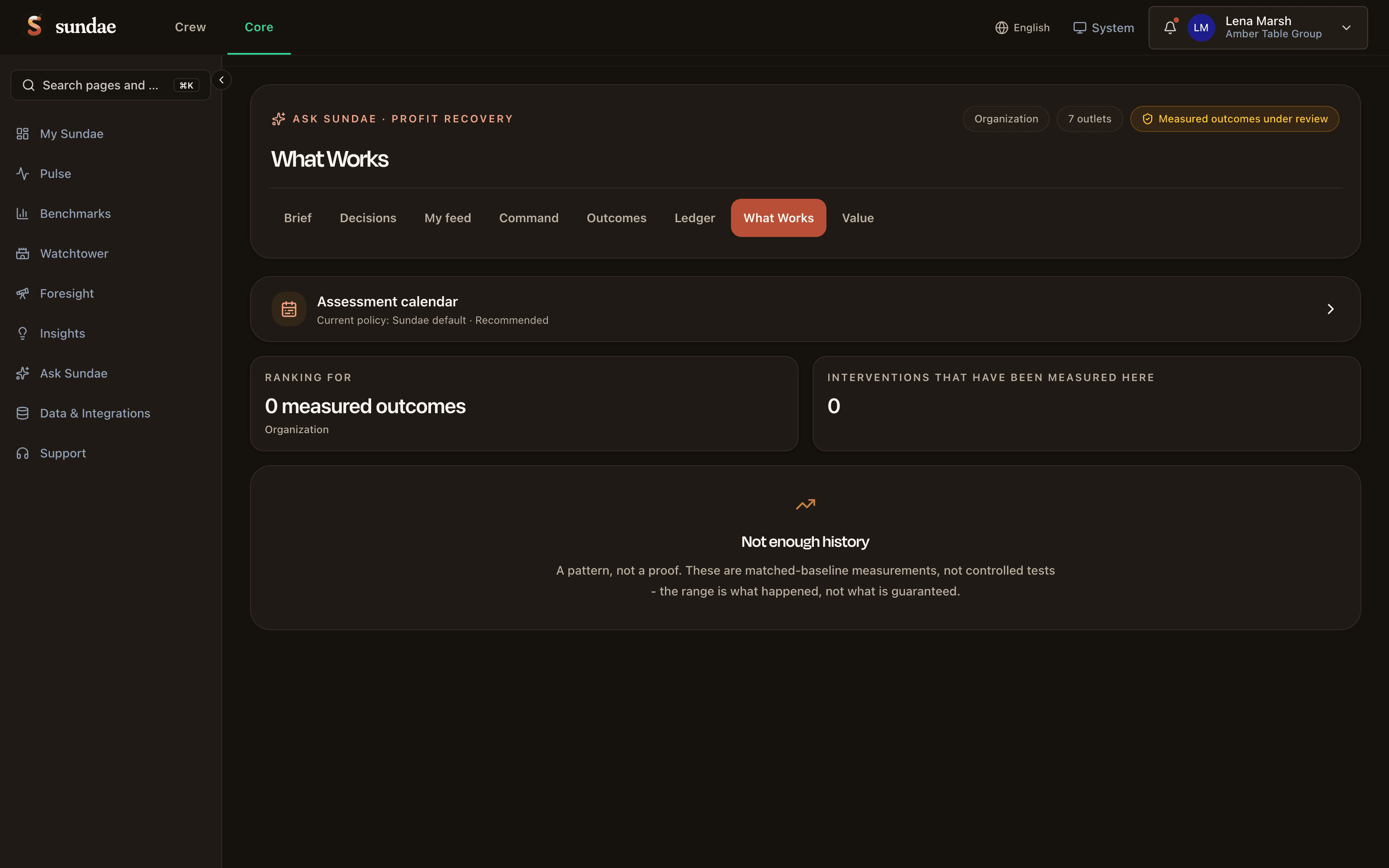
It will not call an estimate recovered.
Identified value remains an estimate. Recovered value is counted only after the work is completed and the result is measured.
It will not give incomplete evidence a green badge.
Missing connector telemetry stays unverified or incomplete. A recent calculation is not treated as proof of a complete dataset.
It will not silently preserve a changed number.
Where source reconciliation is supported, changed records are surfaced without rewriting the historical calculation.
Bring one real operating question.
We will follow it from signal to evidence, owner, action and measurement - and tell you when the data cannot support a claim.